
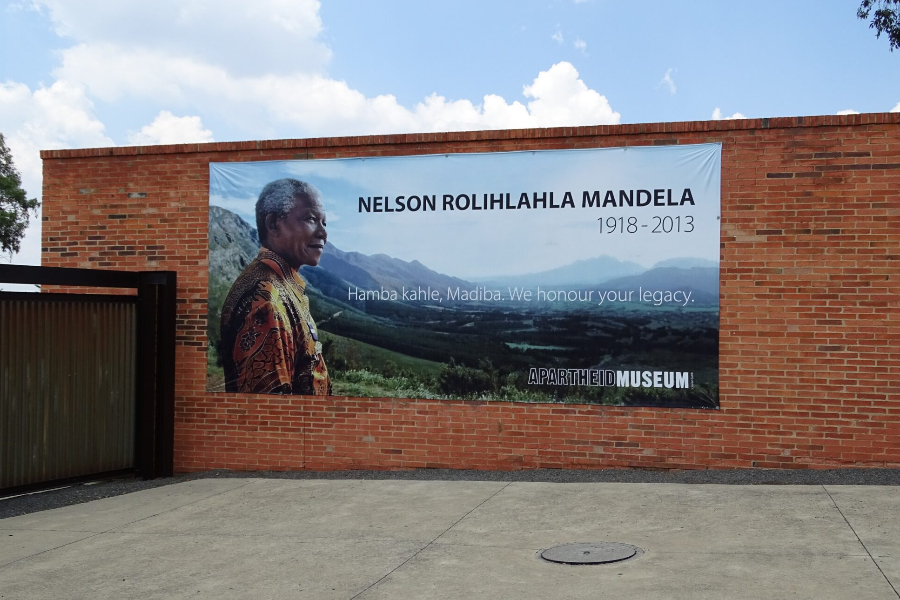


Apartheid Museum - Johannesburg
Gauteng, South Africa South Africa
1. Overview & Significance
- The Apartheid Museum is located in Johannesburg, at the corner of Northern Parkway & Gold Reef Road (Ormonde).
- It opened in November 2001.
- It’s part of the Gold Reef City complex, although it operates independently as a not-for-profit institution. '
- The museum is dedicated to documenting and interpreting the history of apartheid (the institutionalized system of racial segregation in South Africa) and the subsequent struggle for justice, resistance, and democracy.
- It has become an important site of memory, education, and reconciliation, both for South Africans and international visitors.
2. Architecture & Design
- The building is designed to evoke strong emotional responses: materials like rusted steel, red brick, concrete, glass, and wood are used to create contrasts—dark, enclosed spaces versus open, light-filled ones.
- The architecture is symbolic: parts of the building are embedded into the landscape, referencing both Johannesburg’s mining heritage and the underground nature of political resistance.
- On arrival, visitors pass through seven imposing concrete pillars (“Pillars of the Constitution”), each representing one of the fundamental values enshrined in South Africa’s post-apartheid constitution: Democracy, Equality, Reconciliation, Diversity, Responsibility, Respect, Freedom.
- The museum layout is deliberate: visitors start in more confined, oppressive spaces before moving to more open areas, symbolizing the journey from the darkness of apartheid to the light of democracy.
3. Origins & Governance
- The museum was born out of a social-responsibility commitment tied to the Gold Reef City casino license.
- It is a public‑benefit company overseen by an independent board of trustees, not simply a commercial extension of the casino.
- Since it is non-profit, the museum relies on donations, sponsorships, and contributions to maintain its operations.
4. Exhibitions & Key Themes
The museum has a rich and layered exhibition program, divided into three main streams: the Permanent Exhibition, the Mandela Exhibition, and Temporary Exhibitions. Here are some of the core sections and themes:
1. Pillars of the Constitution
o As noted, the seven pillars represent key constitutional values.
o This is the first exhibit visitors encounter, and it sets a tone of reflection and aspiration.
2. Race Classification
o A deeply immersive exhibit: upon entry, visitors are randomly assigned a “race” on their ticket (white/non‑white), and must use a corresponding entrance.
o Original apartheid-era identity documents, “passbooks,” and other items used to enforce racial classification are on display.
o This experiential design helps visitors understand how systemic and arbitrary race was constructed under apartheid.
3. Journeys
o This outdoor exhibit reflects the migration to Johannesburg after the 1886 gold discovery.
o Large photographs show descendants of early migrants — visitors walking in the same direction as these figures mirrors the historical “journey.”
o It highlights the racial diversity that apartheid sought to suppress.
4. Segregation
o Covers the origins of segregation in South Africa, especially around the founding of the Union of South Africa in 1910.
o Explains how early policies disenfranchised many (e.g., black South Africans, white women) and laid the groundwork for apartheid.
5. Apartheid (System & Laws)
o Traces formal apartheid from its legal codification beginning in 1948.
o Presents the political forces, social ideologies, and resistance movements (e.g., ANC, PAC).
o Life-size photographs, archival footage, and authentic artifacts (e.g., removed homes, banned publications) portray daily life under the regime.
6. Turn to Violence & Political Executions
o Documents the escalation of state violence, notably the Sharpeville Massacre (1960) and the rise of armed struggle.
o A particularly powerful exhibit: 131 nooses hang from the ceiling, representing political prisoners executed under apartheid laws.
7. Rise of Black Consciousness
o Focus on the philosophical and social movement led by figures like Steve Biko, advocating psychological and cultural emancipation.
o Highlights how this movement shaped resistance and mobilization.
8. Mandela‑Focused Exhibition
o Chronicles Nelson Mandela’s life: his activism, imprisonment, release, and role in negotiating South Africa’s transition.
o Emphasizes his moral leadership and symbolic importance in the broader national and global struggle for freedom.
9. Road to Democracy
o Covers the transition period: negotiations in the early 1990s, the 1994 general elections, and the drafting of the new constitution.
o Includes audio‑visual recreations of the Constitutional Assembly debates and the atmosphere of that era.
- Balancing Act (LGBTQ+ Stories)
5. Visitor Experience
- Time needed: The museum recommends budgeting at least 2 hours for a meaningful visit.
- Age suitability: Because of graphic content (torture, violence, executions), it is not recommended for children under 11 years.
- Tours:
- Self-guided audio tours are available.
- Guided tours (for adult, student, and pensioner) are offered, and group/school tours must often be pre-booked.
- Accessibility: The museum is wheelchair accessible, with ramps, elevators, and accessible restrooms.
- Admission (as of the latest available data):
- Adults: ~R 170 including audio tour
- Students and pensioners: discounted rate
- Guided tour has a separate rate.
- Facilities: There is a café, lockers, a museum shop, and reflection spaces.
6. Interpretation & Impact
- The museum is not just historical: it's a deeply symbolic space designed to provoke empathy, reflection, and a reckoning with South Africa’s past.
- Its design compels visitors to feel disempowered (narrow corridors, caged-like entry) before guiding them toward more open, hopeful spaces.
- It emphasizes shared values: by starting with the pillars of the constitution, the museum bridges history with contemporary democracy.
- The political execution exhibit (nooses) is particularly potent: it forces the visitor to confront the human cost of resistance and repression.
- Through its temporary and special exhibitions (like Balancing Act), the museum continues to engage with current social justice themes, showing that the legacy of apartheid resonates in ongoing struggles.
- At the end of many tours, visitors are invited to add a stone to a “pile of stones” — a symbolic gesture of commitment to building a just future.
7. Critiques & Challenges
- Some academic critics argue that the museum’s origin (linked to a casino licence) raises questions about commercial vs. moral motivations.
- Others note that while the museum’s narrative is powerful, it may underrepresent certain community perspectives or lived experiences, since the design was not heavily participatory in its early planning.
- As with many memorial museums, balancing memory, education, and tourism is delicate: it must engage tourists without trivializing painful history.
8. Why Visit the Apartheid Museum
- Educational value: For anyone wanting to deeply understand South Africa’s 20th‑century history — especially the apartheid era — this museum is essential.
- Emotional and reflective journey: The design and exhibits are meant to move you, not just inform you — it’s an experience, not just a walk-through.
- Cultural significance: It’s one of the most internationally recognized museums on apartheid, serving as a symbol of reconciliation and national memory.
- Relevance: It connects past struggles to contemporary issues like human rights, democracy, exclusion, and reconciliation.


